This Billionaire might have a "Superpower"
In this post, I want to explore a strange but fascinating possibility: does the billionaire founder of SoftBank, Masayoshi Son, possess a kind of "superpower"?
My reasons for considering this are admittedly speculative, but the dots, once connected, are too interesting not to share.
It all started a few months ago when I stumbled upon a YouTube interview between Son and David Rubenstein. Captivated by Son’s unique demeanor, I ended up reading his biography on Wikipedia. Three distinct stories from his life stood out to me, each escalating in how unexplainable they seem on the surface:
The Unshakable Will
As a young teenager in Japan, Son became obsessed with meeting Den Fujita, the head of McDonald's Japan, whose book he had read. His persistence was relentless. He called Fujita's assistant over 60 times to try and schedule a meeting. When that didn't work, he bought a plane ticket to Tokyo, walked straight into the office, and adamantly asked for a chance to see him. He told the assistant:
"Tell him exactly what I say: You don't have to look at me, you don't have to talk to me, you can keep on working—whatever you're doing. I just want to see his face for three minutes, so I'm not bothering him. I'm just so impressed that I want to see him."
Fujita granted him a 15-minute meeting and gave him a prophetic piece of advice: pursue a career in the computer industry.
The Five-Minute Invention
A few years later, Son decided he wanted to make $10,000 a month while working only five minutes a day. His friends laughed, asking if he planned to sell drugs. But Son reasoned that the highest-leverage path to wealth was raw invention. Every day, for five minutes, he would sit down and command his brain: "Invention come, invention come." It did. He created an electronic translator and sold it to Sharp Corporation for $1.7 million.
The $20 Million Gamble
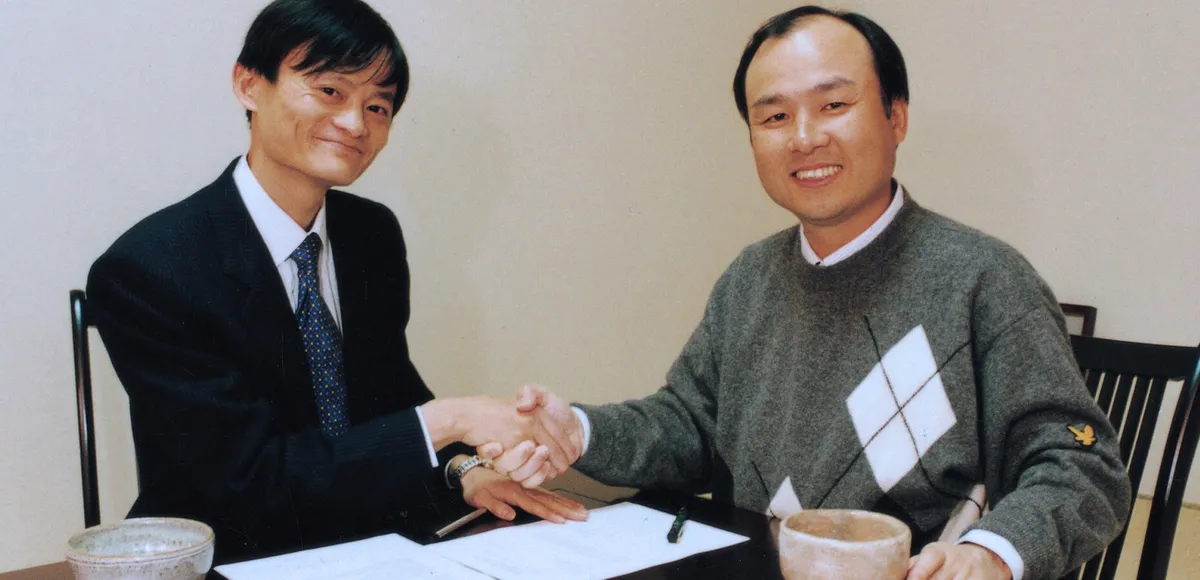
In 1999, Son handed $20 million to Jack Ma for a small startup named Alibaba. At the time, Alibaba had no real business plan, zero revenue, and only 30-40 employees. When asked years later why he made such a massive gamble on an unproven company, Son offered a bizarre explanation: "He had no business plan... but his eyes were very strong. Strong eyes. Shining eyes. I could tell from the way he talked, the way he looked that he had charisma and leadership. His business model was wrong, but he could bring young Chinese people to follow him."
The "Superpower" or "Siddhi"
Investing $20 million because you liked someone’s "strong and shining eyes" sounds absurd to an ordinary person. But Masayoshi Son does not seem like an ordinary person to me.
This brings me to my theory: Son may possess a Siddhi, a term from Hindu philosophy describing extraordinary or perceptual ability.
In Patañjali’s Yoga Sutras (IV.1), it is written: "Accomplishments [siddhis] may be attained through birth, the use of herbs, incantations, self-discipline or samadhi." While traditional commentary cautions that siddhis are merely milestones rather than the ultimate goal of spiritual liberation, they represent a deep, intuitive mastery over nature and perception.
What if Son’s superpower is a specific type of intuitive Siddhi, an innate ability to perceive human character and potential at a depth invisible to normal analysis? What if the eyes truly are the window to the soul?
It would reframe his past. Why was he so obsessively driven to meet Den Fujita face-to-face as a teenager? Perhaps, even then, he was aware of his ability and wanted to see what kind of person is able to reach the top in business. Decades later, recognizing that kind of spark in Jack Ma’s eyes, he didn't need to see a balance sheet. He had already seen the future of the company in the man leading it.
It is easy to dismiss intuitive leaps as luck, especially in today's world of data-driven decisions. But when intuition consistently yields billion-dollar results, it stops looking like luck and starts looking like a talent operating on a completely different frequency.